Part I: Stellar Structure and Evolution
Stars are self-gravitating spheres of plasma in hydrostatic equilibrium, powered by nuclear fusion in their cores. Understanding stellar structure and evolution is fundamental to astrophysics, connecting nuclear physics, thermodynamics, and general relativity to explain the life cycles of stars from birth to their ultimate fate as white dwarfs, neutron stars, or black holes.
Equations of Stellar Structure
The structure of a star in hydrostatic equilibrium is governed by four fundamental differential equations that relate mass, pressure, temperature, and luminosity as functions of radius:
1. Mass Conservation (Continuity Equation)
The mass $M(r)$ enclosed within radius $r$ increases with the local density $\rho(r)$:
2. Hydrostatic Equilibrium
Pressure gradient balances gravitational force per unit volume:
This equation ensures the star neither collapses under gravity nor expands from pressure forces.
3. Energy Transport (Radiative or Convective)
For radiative transport, the temperature gradient depends on the local luminosity and opacity:
where $\kappa$ is the opacity, $a$ is the radiation constant, and $c$ is the speed of light.
Convective Transport:
When the radiative gradient exceeds the adiabatic gradient, convection becomes more efficient. The criterion is given by the Schwarzschild criterion: $\nabla_{\text{rad}} > \nabla_{\text{ad}}$
4. Energy Generation
Luminosity $L(r)$ increases with local energy generation rate $\epsilon(r)$ (energy per unit mass per unit time):
where $\epsilon(r) = \epsilon_{\text{nuc}} - \epsilon_{\nu} + \epsilon_{\text{grav}}$ includes nuclear burning, neutrino losses, and gravitational contraction/expansion.
Boundary Conditions:
At the center $(r=0)$: $M(0) = 0$, $L(0) = 0$
At the surface $(r=R)$: $M(R) = M_*$, $P(R) \approx 0$, $L(R) = L_*$
Energy Generation via Nuclear Fusion
Stars generate energy through nuclear fusion reactions that convert lighter elements into heavier ones, releasing energy according to Einstein's mass-energy equivalence.
Proton-Proton (pp) Chain
Dominant in stars with $M \lesssim 1.5 M_\odot$ and core temperatures $T_c \sim 10^7$ K (like our Sun):
Energy released: $Q = 26.73$ MeV (with ~0.5 MeV lost to neutrinos)
Energy generation rate: $\epsilon_{pp} \propto \rho X^2 T^4$ where $X$ is the hydrogen mass fraction.
CNO Cycle
Dominant in more massive stars ($M \gtrsim 1.5 M_\odot$) with $T_c \sim 1.5 \times 10^7$ K:
Energy generation rate: $\epsilon_{CNO} \propto \rho X X_{CNO} T^{16}$ (much stronger temperature dependence!)
Advanced Burning Stages (Massive Stars)
| Stage | Temperature (K) | Duration | Products |
|---|---|---|---|
| H burning | $\sim 10^7$ | $\sim 10^7$ yr | $^4\text{He}$ |
| He burning | $\sim 10^8$ | $\sim 10^6$ yr | $^{12}\text{C}, {^{16}\text{O}}$ |
| C burning | $\sim 6 \times 10^8$ | ~1000 yr | $^{20}\text{Ne}, {^{23}\text{Na}}, {^{24}\text{Mg}}$ |
| Ne burning | $\sim 1.2 \times 10^9$ | ~1 yr | $^{16}\text{O}, {^{24}\text{Mg}}$ |
| O burning | $\sim 1.5 \times 10^9$ | ~6 months | $^{28}\text{Si}, {^{32}\text{S}}$ |
| Si burning | $\sim 3 \times 10^9$ | ~1 day | $^{56}\text{Fe}, {^{56}\text{Ni}}$ |
Iron-56 has the highest binding energy per nucleon. Further fusion is endothermic, leading to core collapse.
Stellar Evolution from Main Sequence to Compact Remnants
Low-Mass Stars ($M < 2 M_\odot$)
Intermediate-Mass Stars ($2 M_\odot < M < 8 M_\odot$)
Similar evolution to low-mass stars but with:
- CNO cycle dominates on main sequence
- Non-degenerate He ignition (no flash)
- More massive C/O or O/Ne white dwarf remnants
- Approach Chandrasekhar limit: $M_{Ch} = 1.44 M_\odot$
Massive Stars ($M > 8 M_\odot$)
- Neutron Star if $M_{\text{remnant}} < 2-3 M_\odot$
- Black Hole if $M_{\text{remnant}} > 2-3 M_\odot$
Hertzsprung-Russell Diagram
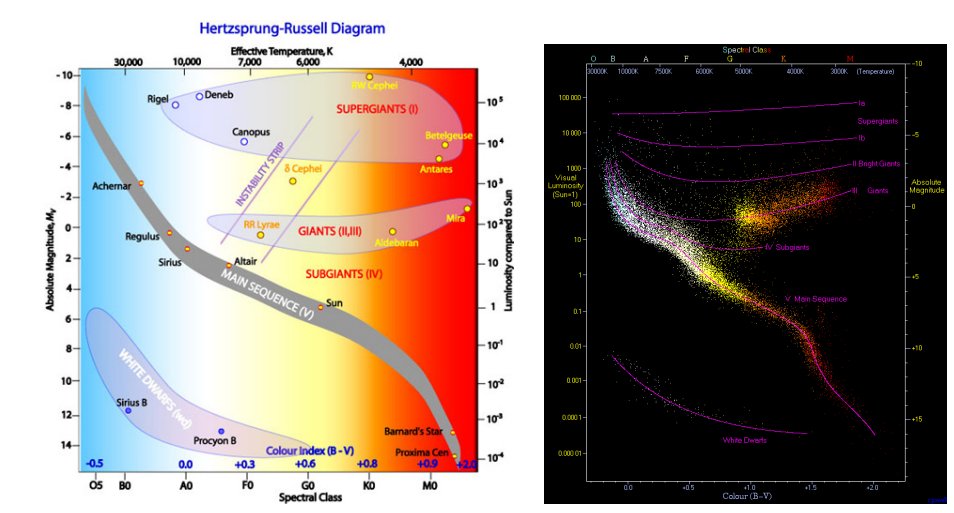
The HR diagram is a fundamental tool in stellar astrophysics, plotting stellar luminosity (or absolute magnitude) versus surface temperature (or spectral type/color index). It reveals stellar properties and evolutionary states.
Main Sequence (Luminosity Class V)
Diagonal band where stars spend ~90% of their lifetime. H burning in core.
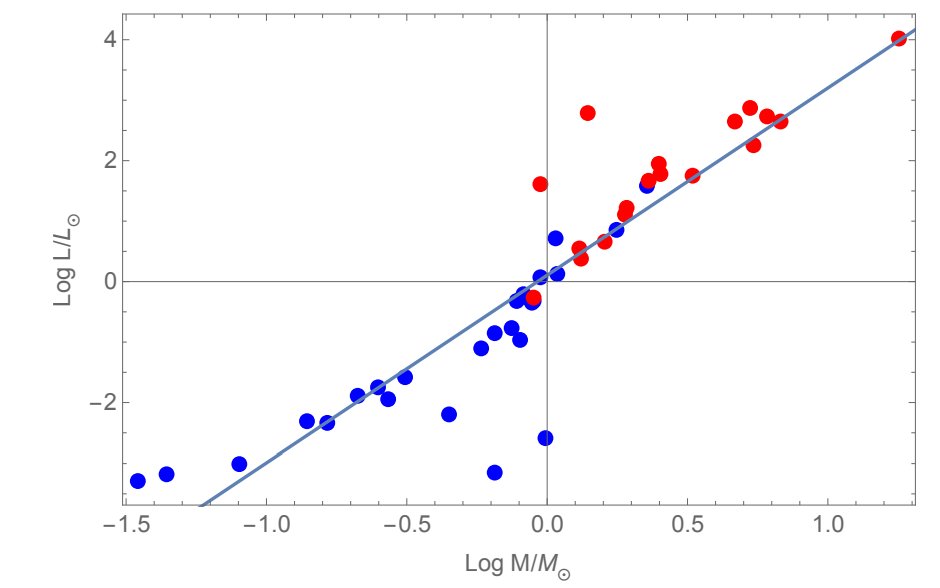
Mass-Luminosity Relation:
More massive stars are much more luminous. A $10 M_\odot$ star is $\sim 3000\times$ more luminous than the Sun!
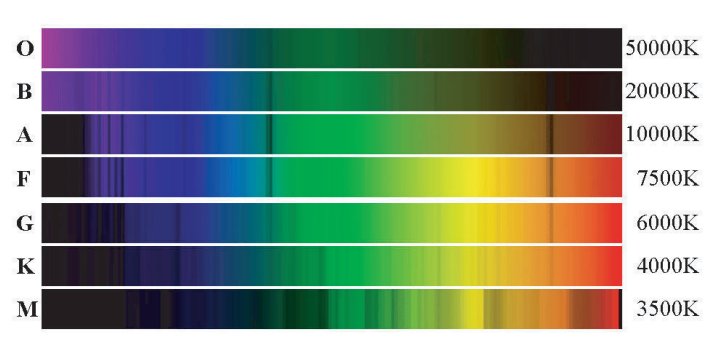
Spectral Classes: O (hottest, blue, $T > 30000$ K) → B → A → F → G (Sun) → K → M (coolest, red, $T < 3500$ K)
Giants and Supergiants
- Red Giants (Class III): Cool, luminous stars. $R \sim 10-100 R_\odot$,$L \sim 10-1000 L_\odot$. Post-MS evolution.
- Supergiants (Class I): Most luminous stars. $L > 10^4 L_\odot$,$R > 100 R_\odot$. Betelgeuse: $R \sim 1000 R_\odot$!
White Dwarfs
Hot but faint. Lower-left corner of HR diagram. $T \sim 10^4$ K, $L \sim 10^{-3} L_\odot$,$R \sim 0.01 R_\odot$. Cooling remnants, no nuclear burning.
Cepheid Instability Strip
Vertical region where stars pulsate radially. Includes Cepheid variables and RR Lyrae stars.
Period-Luminosity Relation (Leavitt's Law):
$$M_V = -2.43 \log_{10}(P) - 4.05$$
where $P$ is pulsation period in days. Critical for distance measurements (standard candles)!
Stellar Populations
Stellar populations are classified by age, metallicity, and location, reflecting the chemical evolution of galaxies.
Population I (Young, Metal-Rich)
- Age: $< 10$ Gyr (includes very young stars)
- Metallicity: $[Fe/H] \sim 0$ (solar or higher)
- Location: Galactic disk, spiral arms
- Kinematics: Circular orbits in disk, low velocity dispersion
- Examples: Sun, O/B stars in spiral arms, open clusters (Pleiades)
- Metallicity Definition: $Z = \frac{\text{mass in elements heavier than He}}{\text{total mass}}$.$Z_\odot \approx 0.02$
Population II (Old, Metal-Poor)
- Age: $> 10$ Gyr (formed early in galaxy)
- Metallicity: $[Fe/H] < -1$ (1% to 10% solar)
- Location: Galactic halo, bulge, globular clusters
- Kinematics: Elliptical orbits, high velocity dispersion
- Examples: RR Lyrae stars, globular clusters (M13, M15)
- Significance: Formed from primordial gas enriched only by early supernovae
Population III (Primordial, Zero Metallicity)
Hypothetical first generation of stars ($Z = 0$), formed from pristine Big Bang material (only H, He, trace Li).
- Expected Mass: Very massive ($M \sim 100-1000 M_\odot$) due to lack of metal-line cooling
- Lifetime: Short ($\sim 2-3$ Myr), all died by $z \sim 20$
- Fate: Core-collapse supernovae or direct collapse to black holes (pair-instability SNe)
- Impact: First metal enrichment, reionization of the universe
- Detection: Never observed directly; signatures sought in extremely metal-poor stars and high-redshift galaxies
Nucleosynthesis
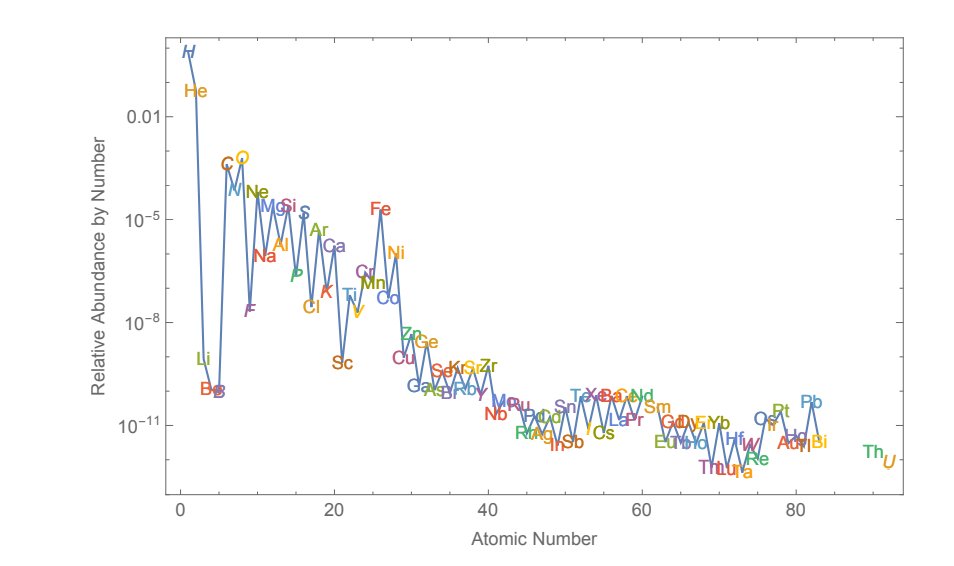
The creation of chemical elements through nuclear reactions in stars and the Big Bang. Stars are the factories that produce nearly all elements heavier than helium.
Big Bang Nucleosynthesis (BBN)
First 20 minutes after Big Bang ($t \sim 10$ s to 20 min, $T \sim 10^9$ K to $10^8$ K):
- Produced: ~75% H, ~25% $^4\text{He}$ (by mass), trace $^2\text{H}$, $^3\text{He}$, $^7\text{Li}$
- No significant production of elements heavier than Li (gap at mass 5, 8)
- Primordial $^4\text{He}$ abundance: $Y_p \approx 0.24-0.25$ (mass fraction)
Stellar Nucleosynthesis
- H → He (main sequence): all stars $M > 0.08 M_\odot$
- He → C, O (red giants): stars $M > 0.5 M_\odot$
- C → Ne, Mg and beyond: massive stars $M > 8 M_\odot$
- Builds elements up to Fe peak ($A \sim 56$)
Sequential alpha-particle captures. Produces C, O, Ne, Mg, Si, S, Ar, Ca ($A = 4n$ nuclei). Example: Triple-alpha process $3{^4\text{He}} \to {^{12}\text{C}}$
Neutron Capture Processes
Elements heavier than iron cannot be produced by fusion (endothermic). Created via neutron capture:
s-process (slow)
- Neutron flux: $\sim 10^8$ n/cm²/s
- Timescale: years (slower than $\beta$-decay)
- Site: AGB stars (He-shell flashes)
- Products: Sr, Y, Zr, Ba, La, Pb
- Follows valley of beta stability
r-process (rapid)
- Neutron flux: $\sim 10^{22}$ n/cm²/s
- Timescale: seconds (faster than $\beta$-decay)
- Site: Core-collapse SNe, neutron star mergers
- Products: Eu, Au, Pt, U, Th
- Creates very neutron-rich nuclei
GW170817 Confirmation:
First neutron star merger observed via gravitational waves (2017) showed clear signatures of r-process nucleosynthesis in the kilonova afterglow, producing $\sim 10 M_\oplus$ of gold and platinum!
Explosive Nucleosynthesis
During supernova explosions, extreme conditions create additional nuclei:
- Explosive burning: Si → Fe peak at $T \sim 5 \times 10^9$ K in seconds
- Photodisintegration: $^{56}\text{Ni}$ production (decays to $^{56}\text{Fe}$, powers SN light curve)
- r-process: Neutron-rich environment, rapid captures
- Cosmic rays: Spallation produces Li, Be, B ($Z = 3, 4, 5$)
Galactic Chemical Evolution
Metallicity increases over cosmic time as successive generations of stars enrich the ISM:
Simple Closed-Box Model:
where $y$ is the yield (fraction of stellar mass returned as metals).
Observations: Metal-poor halo stars have [Fe/H] down to -5.5 (10⁻⁵·⁵ = 0.00003 solar!), indicating enrichment from just a few Pop III supernovae.
Key Equations Summary
Further Reading & Prerequisites
- Thermodynamics (equation of state, thermal equilibrium)
- Statistical Mechanics (degeneracy pressure, Maxwell-Boltzmann distribution)
- Quantum Mechanics (Pauli exclusion, tunneling for fusion rates)
- General Relativity (for compact objects, TOV equation)
- Part II: Compact Objects (white dwarfs, neutron stars, black holes)
- Black Holes (detailed treatment of stellar-mass to supermassive BHs)
- Plasma Physics (stellar interiors, solar corona)
- Kippenhahn, Weigert & Weiss: Stellar Structure and Evolution
- Hansen, Kawaler & Trimble: Stellar Interiors
- Prialnik: An Introduction to the Theory of Stellar Structure and Evolution
- Carroll & Ostlie: An Introduction to Modern Astrophysics
MIT: Cosmic Origin of the Chemical Elements
A complete lecture series from MIT (RES.8-007) tracing the cosmic origin of the chemical elements, from the Big Bang through stellar nucleosynthesis to the formation of the heaviest elements.
Ep. 1: Introduction and Overview
Ep. 2: What the Universe Is Made of
Ep. 3: Early Chemical Evolution
Ep. 4: The First Chemical Enrichment Events
Ep. 5: Stellar Archaeology
Ep. 6: Element Production (Fusion) — Part 1
Ep. 7: Element Production (Fusion) — Part 2
Ep. 8: Spectroscopy
Ep. 9: Formation of the Heaviest Elements
Ep. 10: Telescopes and Observing
Ep. 11: Summary