Special Relativity
⚡ Einstein's Revolutionary Theory
In 1905, Albert Einstein published a paper that revolutionized physics: special relativity. Two simple postulates—the laws of physics are the same in all inertial frames, and the speed of light is constant—led to profound consequences: time dilation, length contraction, simultaneity is relative, and energy and mass are equivalent (E = mc²).
🎯 Key Concepts
- • Spacetime and Minkowski diagrams
- • Lorentz transformations
- • Time dilation and length contraction
- • Relativistic energy and momentum
🔬 Applications
- • Particle accelerators and colliders
- • GPS satellite time corrections
- • Nuclear energy and mass-energy equivalence
- • Foundation for general relativity
📐 Fundamental Principles
First Postulate: Principle of Relativity
The laws of physics are the same in all inertial reference frames. There is no absolute rest frame or absolute motion—only relative motion between observers matters.
Second Postulate: Constancy of Light Speed
The speed of light in vacuum (c ≈ 3 × 10⁸ m/s) is the same for all observers, regardless of their motion or the motion of the light source. This leads to the unification of space and time.
Key Equations and Derivations
Below we derive the central equations of special relativity from Einstein's two postulates. Each result follows logically from the ones before it, forming a self-contained deductive structure.
1. The Lorentz Factor
Light-clock thought experiment: Consider a clock consisting of two mirrors separated by distance d, with a photon bouncing between them. In the clock's rest frame the round-trip time is \(\Delta\tau = 2d/c\). An observer who sees the clock moving at speed v observes the photon traveling a longer, diagonal path of length\(2\sqrt{d^2 + (v\Delta t/2)^2}\). Since the speed of light is c in both frames:
Squaring both sides and solving for \(\Delta t\) in terms of \(\Delta\tau = 2d/c\):
Defining the Lorentz factor:
Properties: \(\gamma = 1\) when \(v = 0\) (non-relativistic limit);\(\gamma \to \infty\) as \(v \to c\). Always \(\gamma \geq 1\). Convenient shorthand: \(\beta = v/c\), so \(\gamma = (1-\beta^2)^{-1/2}\).
2. Lorentz Transformations
Derivation from the two postulates: We seek the most general linear transformation between inertial frames S and S' (where S' moves with velocity v along x) that preserves the speed of light. Linearity is required so that free particles remain free. Consider a light flash emitted at the origin: both frames must see a spherical wavefront expanding at speed c, i.e., \(c^2t^2 - x^2 = c^2t'^2 - x'^2 = 0\). The unique linear transformation satisfying this is:
The transverse coordinates are unchanged: \(y' = y,\; z' = z\). In matrix form this is a hyperbolic rotation (boost) in the \((ct, x)\) plane:
Introducing the rapidity \(\phi\) via \(\tanh\phi = \beta\), the matrix becomes \(\begin{pmatrix}\cosh\phi & -\sinh\phi \\ -\sinh\phi & \cosh\phi\end{pmatrix}\), showing that Lorentz boosts are hyperbolic rotations. Successive boosts with rapidities \(\phi_1\) and \(\phi_2\) yield rapidity \(\phi_1 + \phi_2\) -- rapidities add, but velocities do not (see Eq. 5).
3. Time Dilation
From the Lorentz transformation: A clock at rest in S' sits at fixed \(x' = 0\). It ticks at intervals \(\Delta\tau\) (proper time). Setting \(x' = 0\) in \(x' = \gamma(x-vt)\) gives \(x = vt\), and substituting into \(t' = \gamma(t - vx/c^2)\):
Rearranging:
Since \(\gamma \geq 1\), the coordinate time \(\Delta t\) is always larger than the proper time \(\Delta\tau\): moving clocks run slow.
Twin Paradox Example
Twin A stays on Earth; Twin B travels at \(v = 0.8c\) (\(\gamma = 5/3\)) for 10 years (Earth time) and returns. Twin A ages 20 years total, while Twin B ages only \(20/\gamma = 12\) years. The paradox is resolved by noting that Twin B must accelerate (change frames) to turn around, breaking the symmetry between the two twins.
4. Length Contraction
From simultaneity in the Lorentz transform: A rod at rest in S' has proper length \(L_0 = x'_2 - x'_1\). To measure its length in S, we must mark both endpoints simultaneously in S (at the same time t). Using \(x' = \gamma(x - vt)\):
Solving for L:
Objects are contracted only along the direction of motion. Since \(\gamma \geq 1\),\(L \leq L_0\): moving objects appear shorter. Note that this is not a visual appearance effect (which involves light travel time) but a genuine coordinate measurement.
5. Relativistic Velocity Addition
Derivation from the Lorentz transforms: An object moves with velocity \(u = dx/dt\) in frame S. What is its velocity \(u' = dx'/dt'\)in frame S'? Differentiate the Lorentz transforms:
Dividing \(dx'\) by \(dt'\) and factoring out dt:
Key check: if \(u = c\), then \(u' = (c-v)/(1-v/c) = c\) -- the speed of light is invariant, as required. For \(u, v \ll c\) the denominator approaches 1 and we recover the Galilean result \(u' = u - v\). No combination of sub-light velocities can exceed c.
6. The Spacetime Interval
The fundamental invariant: Define the spacetime interval between two events:
Proof of invariance: Substitute the Lorentz transformations into \(c^2\Delta t'^2 - \Delta x'^2\):
Classification: \(\Delta s^2 > 0\) (timelike -- causal connection possible),\(\Delta s^2 = 0\) (lightlike -- connected by light),\(\Delta s^2 < 0\) (spacelike -- no causal connection). The proper time along a worldline is \(d\tau = ds/c\).
7. Four-Momentum and the Energy-Momentum Relation
Constructing the four-momentum: The four-velocity is \(U^\mu = dx^\mu/d\tau = \gamma(c, \mathbf{v})\). Multiplying by the rest mass m defines the four-momentum:
Computing the Lorentz-invariant inner product \(p_\mu p^\mu\) using the Minkowski metric \(\eta_{\mu\nu} = \text{diag}(+1,-1,-1,-1)\):
Rearranging gives the celebrated energy-momentum relation:
For massless particles (\(m=0\)): \(E = pc\) (photons). For particles at rest (\(\mathbf{p}=0\)): \(E = mc^2\) (rest energy). This relation is the foundation of particle physics kinematics.
8. Mass-Energy Equivalence
From the relativistic work-energy theorem: The relativistic force is \(F = dp/dt = d(\gamma mv)/dt\). The work done accelerating a particle from rest:
Integrating by parts and using \(d(\gamma v) = \gamma^3\,dv\):
Since \(W = K\) (kinetic energy) and total energy = kinetic + rest energy:
\(E_0 = mc^2\) is the rest energy -- mass itself is a form of energy. This is the physical basis of nuclear energy: a small mass deficit \(\Delta m\)releases enormous energy \(\Delta E = \Delta m\, c^2\).
9. Relativistic Doppler Effect
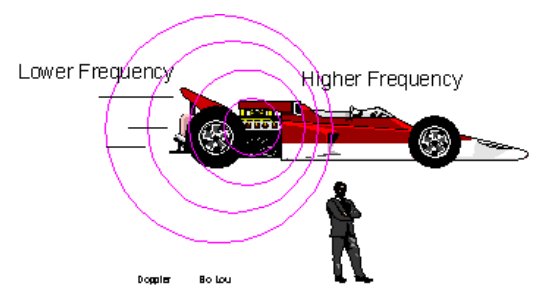
Derivation: A source emitting light of frequency \(f_s\) moves toward the observer at speed v. In the source's frame, the period between crests is \(T_s = 1/f_s\). Due to time dilation, the observer measures the source's period as \(\gamma T_s\). During this time the source has moved closer by \(v\gamma T_s\), reducing the wavelength by that amount. The observed frequency is:
Using \(1 - \beta^2 = (1-\beta)(1+\beta)\):
For a receding source, replace \(\beta \to -\beta\). Unlike the classical Doppler effect, there is also a transverse Doppler effect (\(f_{\text{obs}} = f_s/\gamma\)) due to time dilation alone, with no classical analogue.
10. Relativistic Kinetic Energy
Definition: Total energy minus rest energy:
Classical limit: For \(v \ll c\), expand \(\gamma\) in a Taylor series:
Therefore:
The first term is the familiar Newtonian kinetic energy. Higher-order terms are relativistic corrections. Note that as \(v \to c\), \(K \to \infty\), which is why no massive object can reach the speed of light -- it would require infinite energy.
Summary Table
| Equation | Formula | Physical Meaning |
|---|---|---|
| Lorentz Factor | \(\gamma = (1-v^2/c^2)^{-1/2}\) | Universal relativistic scaling factor |
| Lorentz Transform | \(x'=\gamma(x-vt)\) | Coordinate transformation between frames |
| Time Dilation | \(\Delta t = \gamma\,\Delta\tau\) | Moving clocks run slow |
| Length Contraction | \(L = L_0/\gamma\) | Moving objects are shorter |
| Velocity Addition | \(u'=(u-v)/(1-uv/c^2)\) | Velocities don't simply add |
| Spacetime Interval | \(\Delta s^2 = c^2\Delta t^2 - \Delta x^2\) | Invariant under Lorentz transforms |
| Energy-Momentum | \(E^2 = (pc)^2 + (mc^2)^2\) | Relativistic energy-momentum relation |
| Mass-Energy | \(E = \gamma mc^2\) | Mass is a form of energy |
| Doppler Effect | \(f_{\text{obs}} = f_s\sqrt{\frac{1+\beta}{1-\beta}}\) | Frequency shift from moving source |
| Kinetic Energy | \(K = (\gamma-1)mc^2\) | Reduces to \(\frac{1}{2}mv^2\) for \(v \ll c\) |
📚 Course Content
Spacetime Foundations
- • Historical context: Galilean relativity and Maxwell's equations
- • Michelson-Morley experiment and the aether
- • Einstein's postulates and their consequences
- • Minkowski spacetime and light cones
- • Proper time and worldlines
Lorentz Transformations
- • Derivation from Einstein's postulates
- • Time dilation and length contraction
- • Relativity of simultaneity
- • Velocity addition formula
- • Lorentz transformation as rotation in spacetime
Relativistic Mechanics
- • Four-vectors: position, velocity, momentum, acceleration
- • Relativistic momentum: p = γmv
- • Relativistic energy: E = γmc²
- • Mass-energy equivalence and nuclear reactions
- • Conservation laws in relativistic collisions
Electromagnetism in SR
- • Electric and magnetic fields are frame-dependent
- • Electromagnetic field tensor F^μν
- • Covariance of Maxwell's equations
- • Four-current and charge conservation
- • Transformation of E and B fields between frames
🔗 Connections to Other Courses
Prerequisites:
- • Classical Mechanics: Lagrangian formalism
- • Tensor Calculus: Four-vectors and tensors
- • Waves & Optics: Electromagnetic waves
Leads to:
- • General Relativity: Curved spacetime and gravity
- • Quantum Field Theory: Relativistic quantum mechanics
- • Cosmology: Expanding universe
📺 Video Lectures
World-class lectures on special relativity from leading physicists and science communicators.
WSU: Space, Time, and Einstein with Brian Greene
Physicist and acclaimed science communicator Brian Greene delivers an engaging lecture at Wright State University, exploring Einstein's special relativity. He explains how space and time are interwoven into a single spacetime continuum, and how the counterintuitive consequences of relativity emerge from Einstein's two simple postulates.
Topics Covered:
- The constancy of the speed of light and its implications
- Time dilation and the twin paradox
- Length contraction and relativity of simultaneity
- $E = mc^2$ and the equivalence of mass and energy
- Spacetime diagrams and Minkowski geometry
MIT 8.20 Special Relativity - Prof. Markus Klute
MIT's undergraduate course on Special Relativity taught by Prof. Markus Klute. These lectures provide a rigorous introduction to Einstein's special theory of relativity with historical context and modern applications.
L1.2: Prof. Klute's Research
Introduction to high-energy physics research at MIT and CERN.
L1.3: History of Special Relativity
The historical development of special relativity from Galileo to Einstein.
L1.4: Space, Time, and Spacetime (Guest)
Guest lecture exploring the conceptual foundations of spacetime.
L1.5: Categories of Physics
Overview of different branches of physics and their interconnections.
L2.1: Events
Introduction to events as fundamental objects in spacetime.
L2.2: Galilean Transformation
Classical Galilean relativity and coordinate transformations.
Leonard Susskind's Theoretical Minimum Series
This course also features 10 lectures from Prof. Leonard Susskind's renowned "Theoretical Minimum" series at Stanford. Susskind's clear explanations make even the most counterintuitive aspects of special relativity accessible and understandable.
Watch Susskind Lectures →Learning Path & Prerequisites
Hover over nodes to see connections. Click to lock selection. Colored nodes link to course content.
Related Courses
General Relativity
Next step: curved spacetime, Einstein field equations, and gravitational physics
Quantum Mechanics
The other pillar of modern physics: operators, measurement, and wave-particle duality
Classical Mechanics
Foundation: Lagrangian and Hamiltonian mechanics, the non-relativistic limit
Cosmology
Apply relativity to the universe: Big Bang, expansion, and dark energy