Graduate Research Course
Bee Biophysics & Biochemistry
From unsteady aerodynamics to swarm intelligence — flight mechanics, waggle dance navigation, honeycomb optimization, and the physics of the superorganism.
Key Equations of Bee Biophysics
Leading-Edge Vortex Lift
\( L = \frac{1}{2}\rho v^2 S \cdot C_L^{LEV}(\alpha, \dot{\alpha}) \)
Waggle Dance Vector
\( \vec{d} = d(\cos\theta, \sin\theta), \quad \theta = \theta_{sun} + \theta_{waggle} \)
Honeycomb Theorem
\( \text{Regular hexagon minimises } \frac{\text{perimeter}}{\text{area}} = \frac{2\sqrt{2\sqrt{3}}}{A^{1/2}} \)
Hamilton's Rule
\( rB > C \quad (r = 3/4 \text{ for haplodiploid sisters}) \)
Hive Thermostat
\( C\frac{dT}{dt} = \dot{Q}_{metabolic} - hA(T - T_{amb}) - \dot{Q}_{fan} \)
Swarm Quorum
\( \frac{dN_i}{dt} = \alpha_i N_0 - \beta N_i + \gamma N_i^2 / (N_i + K) \)
About This Course
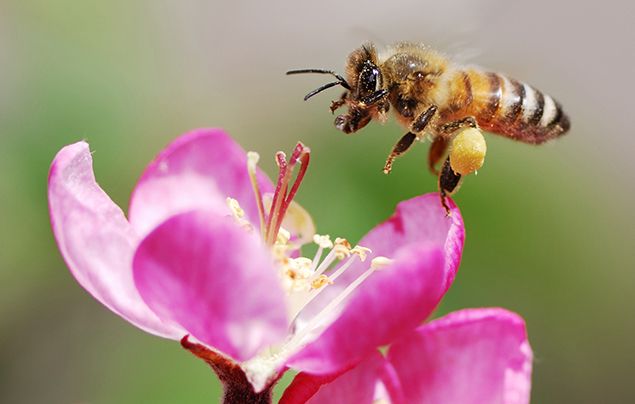
The honeybee (Apis mellifera) is one of the most studied organisms in biophysics. A single bee beats its wings 230 times per second, generating lift through leading-edge vortices that classical aerodynamics once declared impossible. Inside the hive, 50,000 individuals collectively regulate temperature to within ±0.5°C, build mathematically optimal hexagonal combs, and communicate food-source locations via the waggle dance — a symbolic language encoded in vibrational physics.
This course takes a rigorous physics and chemistry approach to every aspect of bee biology: the unsteady aerodynamics of hovering flight, the optics of compound eyes and UV flower patterns, the thermodynamics of hive climate control, the organic chemistry of pheromone signaling, the materials science of beeswax, and the statistical mechanics of swarm decision-making.
Every module includes MathJax derivations, SVG diagrams, and computational models. Cross-links to our Avian Biophysics and Plant Biochemistry courses connect pollination ecology and co-evolution.
Nine Modules
M0
Physical Foundations
Scaling laws at insect scale, Reynolds number regimes, exoskeleton mechanics, and chitin composite materials.
M1
Flight Aerodynamics
Leading-edge vortex generation, delayed stall, wing kinematics, and the energetics of hovering flight.
M2
Vision & Navigation
Compound eye optics, UV pattern detection, polarized-light compass, and the waggle dance communication system.
M3
Thermoregulation & Energetics
Endothermic flight muscle thermogenesis, hive temperature control via fanning and shivering, and metabolic rate scaling.
M4
Olfaction & Communication
Queen mandibular pheromone, alarm and Nasonov pheromones, odorant receptor biophysics, and nestmate recognition.
M5
Honey & Wax Biochemistry
Nectar-to-honey processing, invertase catalysis, the honeycomb theorem, beeswax secretion, and royal jelly caste determination.
M6
Stinger & Venom Biophysics
Barbed stinger mechanics, venom composition and delivery, melittin membrane pore formation, and phospholipase A2 activity.
M7
Collective Intelligence
Nest-site selection via quorum sensing, optimal foraging theory, self-organization in swarms, and emergent colony-level computation.
M8
Evolution & Colony Genetics
Haplodiploidy and kin selection, Hamilton's rule for eusociality, the superorganism concept, and colony collapse disorder.
M9
Molecular & Biochemistry
QMP & 9-ODA queen pheromone (chirality, OR-Orco picomolar binding), royalactin / EGFR caste switch (Kamakura 2011), beeswax wax-ester biosynthesis, melittin & PLA2 venom mechanism, UV vision & flavonoid nectar guides, vitellogenin antioxidant lifespan, neonicotinoid-receptor selectivity.
Recommended Textbooks
- [1] Seeley, T.D. (2010). Honeybee Democracy. Princeton University Press.
- [2] Srinivasan, M.V. (2011). Honeybees as a model for the study of visually guided flight, navigation, and biologically inspired robotics. Physiological Reviews, 91(2), 413–460.
- [3] Tautz, J. (2008). The Buzz about Bees: Biology of a Superorganism. Springer.
- [4] Dickinson, M.H. et al. (1999). Wing rotation and the aerodynamic basis of insect flight. Science, 284(5422), 1954–1960.
- [5] Wilson, E.O. & Hölldobler, B. (2009). The Superorganism. W.W. Norton.
- [6] Hales, T.C. (2001). The honeycomb conjecture. Discrete & Computational Geometry, 25(1), 1–22.