Ion Channels & Electrophysiology
The physics of electrical signaling in neurons: the Nernst equation for ion equilibria, the Goldman-Hodgkin-Katz equation for membrane potential, the Hodgkin-Huxley model of the action potential derived from voltage-clamp data, the cable equation for signal propagation, and patch clamp electrophysiology.

Table of Contents
1. The Nernst Equation
Derivation from Electrochemical Equilibrium
Consider a membrane permeable to a single ion species with charge $z$. At equilibrium, the electrochemical potential must be equal on both sides:
The electrochemical potential is:
Setting $\tilde{\mu}_{\text{in}} = \tilde{\mu}_{\text{out}}$:
Solving for the equilibrium potential $E = \phi_{\text{in}} - \phi_{\text{out}}$:
At 37°C, $RT/F = 26.7$ mV. For $z = +1$, a tenfold concentration ratio gives $E = 61.5$ mV. For typical mammalian neurons:$E_K \approx -90$ mV, $E_{Na} \approx +60$ mV,$E_{Ca} \approx +130$ mV, $E_{Cl} \approx -85$ mV.
2. Goldman-Hodgkin-Katz Equation
Derivation from the Nernst-Planck Equation
When the membrane is permeable to multiple ions, the Nernst equation is insufficient. We start from the Nernst-Planck equation for the flux of ion $i$:
The key assumption of the GHK model is a constant electric fieldwithin the membrane: $d\phi/dx = -V_m/d$, where $d$ is membrane thickness and $V_m$ is membrane potential.
Under this assumption, the steady-state current for each ion can be integrated across the membrane. For monovalent ions (K$^+$, Na$^+$, Cl$^-$), setting the total current to zero gives the GHK voltage equation:
where $P_i$ is the permeability of ion $i$. Note that Cl$^-$ concentrations are swapped (inside vs outside) due to the negative charge.
At rest, $P_K \gg P_{Na} \gg P_{Cl}$ (typical ratio 1 : 0.04 : 0.45), giving $V_m \approx -70$ mV. During the action potential peak,$P_{Na}$ increases ~500-fold, driving $V_m$ toward$E_{Na} \approx +50$ mV.
GHK Current Equation
The current carried by each ion through the membrane is given by the GHK current equation:
This reduces to Ohm's law ($I = g(V - E)$) for small voltages but shows rectification at larger potentials, as observed experimentally.
3. Hodgkin-Huxley Model
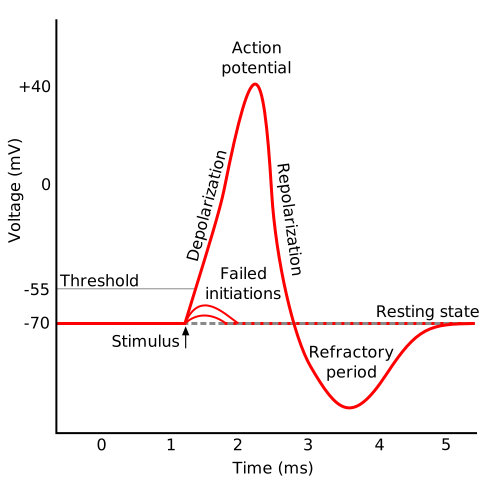
The Circuit Model
Hodgkin and Huxley (1952) modeled the squid giant axon membrane as a parallel RC circuit with voltage-dependent conductances. The membrane current equation is:
where:
- • $m$: Na$^+$ activation gate (3 particles, fast)
- • $h$: Na$^+$ inactivation gate (1 particle, slow)
- • $n$: K$^+$ activation gate (4 particles, intermediate)
Gating Variables: Derivation from Voltage-Clamp Data
Each gating variable $x$ (where $x = m, h, n$) obeys first-order kinetics:
This can be rewritten as relaxation to a steady state:
where $x_\infty = \alpha_x/(\alpha_x + \beta_x)$ and$\tau_x = 1/(\alpha_x + \beta_x)$. Hodgkin and Huxley fitted$\alpha_x(V)$ and $\beta_x(V)$ to their voltage-clamp data:
The Action Potential Mechanism
The action potential emerges from the interplay of the gating dynamics:
- • Threshold (~-55 mV): Depolarization activates Na$^+$ channels ($m$ increases). When inward $I_{Na}$ exceeds outward $I_K + I_L$, a positive feedback loop drives rapid depolarization.
- • Upstroke (0.5 ms): $m$ reaches steady state quickly ($\tau_m \sim 0.1$ ms), $V$ approaches$E_{Na} \approx +50$ mV.
- • Repolarization (1-2 ms): $h$inactivation closes Na$^+$ channels ($\tau_h \sim 1$ ms), while$n$ activation opens K$^+$ channels ($\tau_n \sim 5$ ms).
- • Undershoot: Slow $n$deactivation keeps K$^+$ channels open, driving $V$ below rest toward$E_K$.
- • Refractory period: Until $h$recovers, Na$^+$ channels cannot reopen, preventing another action potential.
4. The Cable Equation
Derivation for a Cylindrical Neuron
Consider a cylindrical neurite of radius $a$. Current conservation in a small segment of length $dx$ gives:
where $r_i = R_i/(\pi a^2)$ is intracellular resistance per unit length,$r_m = R_m/(2\pi a)$ is membrane resistance per unit length, and$c_m = C_m \cdot 2\pi a$ is capacitance per unit length. Defining the electrotonic length constant andmembrane time constant:
the cable equation becomes:
Key result: the space constant scales as $\lambda \propto \sqrt{a}$, so larger axons propagate signals farther. For the squid giant axon ($a = 250\,\mu$m),$\lambda \approx 5$ mm. For a typical mammalian axon ($a = 0.5\,\mu$m),$\lambda \approx 0.2$ mm — hence the need for myelination.
Action Potential Propagation Velocity
For an unmyelinated axon, the propagation velocity scales as:
For a myelinated axon, the velocity scales linearly with diameter:
This explains why the squid evolved a giant axon (500 $\mu$m diameter) for its escape reflex: $v \approx 20$ m/s. In contrast, a myelinated mammalian axon of only 10 $\mu$m achieves $v \approx 60$ m/s.
5. Patch Clamp Electrophysiology
Single-Channel Recording
The patch clamp technique (Neher and Sakmann, Nobel Prize 1991) allows recording of currents through individual ion channels. A glass micropipette with a ~1 $\mu$m tip forms a high-resistance seal ($> 1\, G\Omega$, "gigaseal") with the cell membrane.
Single-channel currents are typically 1-10 pA, corresponding to ion flow rates of$10^6$ to $10^7$ ions per second. The single-channel current is:
where $\gamma$ is the single-channel conductance (5-300 pS) and$E_{\text{rev}}$ is the reversal potential. The macroscopic current is$I = N \cdot p_o \cdot i$, where $N$ is the number of channels and $p_o$ is the open probability.
Channel Gating Kinetics
The simplest model of channel gating is a two-state Markov process:
The open probability at steady state is:
The mean open time is $\tau_o = 1/\beta$ and mean closed time is$\tau_c = 1/\alpha$. Both are exponentially distributed for a two-state channel. More complex channel behavior (bursting, subconductance states) requires models with additional states.
Advanced Electrophysiology Topics
Saltatory Conduction in Myelinated Axons
Myelination increases the membrane resistance and decreases the capacitance by wrapping multiple layers of insulating membrane around the axon. Between the myelin sheaths are Nodes of Ranvier, where ion channels are concentrated. The action potential "jumps" between nodes (saltatory conduction).
For a myelinated axon with $n$ wraps of myelin (thickness $d_m$ each):
The effective space constant in the myelinated segment is greatly increased:
With $n \sim 100$ wraps, $\lambda_{\text{myelin}} \sim 10\lambda_{\text{bare}} \sim 2$ mm, which is comparable to the internode distance (~1-2 mm). The propagation velocity for myelinated fibers scales linearly with diameter ($v \propto d$) rather than as $\sqrt{d}$, giving velocities up to 120 m/s for 20 $\mu$m fibers.
Ion Channel Selectivity
Ion channels achieve remarkable selectivity while maintaining high throughput ($\sim 10^8$ ions/s). The potassium channel selectivity filter uses a sequence of carbonyl oxygen atoms that precisely coordinate dehydrated K$^+$ions, mimicking their hydration shell:
For K$^+$ (radius 1.33 Angstrom), the coordination energy almost exactly compensates the dehydration cost. For Na$^+$ (radius 0.95 Angstrom), the filter is too large, creating a ~12 kJ/mol selectivity barrier. This gives a selectivity ratio of:
Noise Analysis and Channel Fluctuations
Fluctuation analysis of macroscopic currents can reveal single-channel properties without patch clamping. For $N$ identical channels with open probability$p$ and single-channel current $i$:
The variance-mean relationship is linear, with slope $i(1-p)$. By varying the agonist concentration to change $p$, one can extract both $i$ and$N$ from a single cell. The power spectral density of channel noise follows a Lorentzian: $S(f) = S_0/(1 + (f/f_c)^2)$, where$f_c = 1/(2\pi\tau)$ is the corner frequency related to channel kinetics.
Derivation: Nernst Equation from Thermodynamics
Starting Point: Electrochemical Potential
The electrochemical potential of an ion species in solution combines its chemical potential (concentration-dependent) with its electrical potential energy. For an ion of species $i$ with valence $z_i$, the electrochemical potential is:
where $\mu_i^0$ is the standard chemical potential, $R = 8.314$ J/(mol·K) is the gas constant, $T$ is absolute temperature, $c_i$ is the molar concentration (strictly, the activity), $z_i$ is the ion valence (signed integer),$F = 96{,}485$ C/mol is Faraday's constant, and $\varphi$ is the electric potential at the location of the ion.
The term $RT\ln c_i$ arises from the entropy of mixing in an ideal dilute solution (from the Gibbs free energy $G = G^0 + nRT\ln c$). The term$z_i F\varphi$ is the electrical work to move one mole of ions of charge$z_i$ through a potential $\varphi$.
Equilibrium Condition: $\Delta\mu = 0$
At thermodynamic equilibrium, there is no net free energy change for the transfer of ions across the membrane. This means the electrochemical potential must be equal on both sides:
Equivalently, $\Delta\mu = \mu_{\text{in}} - \mu_{\text{out}} = 0$. Substituting the full expression:
The standard chemical potentials $\mu^0$ cancel (same species, same standard state). Rearranging:
Defining the equilibrium (Nernst) potential as $E_{\text{ion}} = \varphi_{\text{in}} - \varphi_{\text{out}}$:
This is the Nernst equation (Walther Nernst, 1889). It gives the membrane potential at which the electrical driving force exactly balances the concentration gradient for a single ion species.
Numerical Calculations for Typical Neuronal Concentrations
At body temperature ($T = 310$ K), the thermal voltage is:
Converting to base-10 logarithms: $E = (RT/zF) \cdot 2.303 \cdot \log_{10}(c_{\text{out}}/c_{\text{in}}) = (61.5\text{ mV}/z)\log_{10}(c_{\text{out}}/c_{\text{in}})$.
Sodium (Na$^+$): $z = +1$,$[\text{Na}^+]_{\text{out}} = 145$ mM, $[\text{Na}^+]_{\text{in}} = 12$ mM:
Potassium (K$^+$): $z = +1$,$[\text{K}^+]_{\text{out}} = 4$ mM, $[\text{K}^+]_{\text{in}} = 155$ mM:
Chloride (Cl$^-$): $z = -1$,$[\text{Cl}^-]_{\text{out}} = 120$ mM, $[\text{Cl}^-]_{\text{in}} = 4.2$ mM:
The Nernst potential for each ion represents the "target" that the membrane potential would reach if the membrane were permeable to only that ion. The actual resting potential ($\approx -70$ mV) lies between $E_K$ and $E_{Na}$, closer to $E_K$ because the resting membrane is much more permeable to K$^+$ than to Na$^+$.
Derivation: Goldman-Hodgkin-Katz Equation
Starting Point: The Nernst-Planck Equation
The flux of ion $i$ across a membrane is governed by the Nernst-Planck equation, which accounts for both diffusion (Fick's law) and electromigration (drift in an electric field):
where $J_i$ is the flux (mol/m$^2$/s), $D_i$ is the diffusion coefficient inside the membrane, $c_i(x)$ is the concentration profile across the membrane, and $\varphi(x)$ is the electric potential profile.
The Constant Field Assumption
Goldman's key simplifying assumption (1943) is that the electric field within the membrane is constant:
where $V_m = \varphi_{\text{in}} - \varphi_{\text{out}}$ is the membrane potential and $d$ is the membrane thickness. Substituting into the Nernst-Planck equation and defining $u = z_i F V_m / RT$ (a dimensionless potential):
This is a first-order linear ODE in $c_i(x)$. Using the integrating factor$\exp(-ux/d)$, we multiply both sides:
Integrating from $x = 0$ (outside) to $x = d$ (inside), with boundary conditions $c_i(0) = \beta_i c_{i,\text{out}}$ and$c_i(d) = \beta_i c_{i,\text{in}}$ (where $\beta_i$ is the partition coefficient):
where the permeability $P_i = \beta_i D_i / d$ encapsulates the membrane's partitioning and diffusion properties.
Setting Total Current to Zero
The current density for each ion is $j_i = z_i F J_i$. At the resting membrane potential, the total current is zero:
For the three principal ions (K$^+$, Na$^+$ with $z = +1$, and Cl$^-$ with $z = -1$), substituting the flux expressions and noting that the $u/(e^u - 1)$ factor is common (for monovalent ions $|u|$ is the same):
Note the sign flip for Cl$^-$ because $z_{Cl} = -1$. Collecting terms with and without $e^{-u}$ and solving for $e^{-u}$:
Taking the natural logarithm and multiplying by $-RT/F$:
How the Resting Potential Arises from Differential Permeabilities
The GHK equation reduces to the Nernst equation when only one ion is permeable. For example, if $P_K \gg P_{Na}, P_{Cl}$:
At rest, the permeability ratios are approximately $P_K : P_{Na} : P_{Cl} = 1 : 0.04 : 0.45$. Substituting typical mammalian concentrations:
During the action potential, Na$^+$ permeability increases dramatically ($P_{Na}/P_K \approx 20$), and the GHK equation predicts:
This demonstrates how the membrane potential swings from near $E_K$ at rest to near $E_{Na}$ at the peak of the action potential, driven entirely by the change in relative permeabilities.
Derivation: Hodgkin-Huxley Model
The Full Cable Equation with Active Conductances
The Hodgkin-Huxley model begins with Kirchhoff's current law applied to a patch of membrane. The total membrane current has a capacitive component and ionic components:
Hodgkin and Huxley decomposed the ionic current into three independent conductance pathways (identified by pharmacological block and ion substitution experiments on the squid giant axon at 6.3°C):
The crucial insight was that the sodium and potassium conductances are voltage-dependent and time-dependent. From their voltage-clamp experiments, they determined the empirical forms:
Substituting and rearranging for the space-clamped case (uniform membrane, no spatial variation), the full HH equation is:
The parameters from squid giant axon at 6.3°C: $C_m = 1\,\mu$F/cm$^2$,$\bar{g}_{Na} = 120$ mS/cm$^2$, $\bar{g}_K = 36$ mS/cm$^2$,$g_L = 0.3$ mS/cm$^2$, $E_{Na} = +50$ mV,$E_K = -77$ mV, $E_L = -54.4$ mV.
Gating Variable Kinetics
Each gating variable $x \in \{m, h, n\}$ represents the fraction of "gating particles" in the permissive state. The kinetic equation follows from a two-state model where each particle transitions between resting (R) and active (A) states with voltage-dependent rates:
If $x$ is the probability a single particle is in state A, then the master equation gives:
This first-order ODE has the general solution:
where the steady-state value and time constant are:
The physical interpretation of the exponents: $m^3$ means three independent activation particles must all be in the permissive state for the Na$^+$ channel to conduct. The probability of all three being open is $m \cdot m \cdot m = m^3$. Similarly, $n^4$ requires four K$^+$ activation particles to be open. The factor $h$ represents a single inactivation particle that must not be in the blocking state.
Voltage-Dependent Rate Constants and the Action Potential
Hodgkin and Huxley fitted the rate constants to empirical functions of voltage. The functional forms are motivated by Eyring rate theory, where the transition rate over an energy barrier is modified by the membrane electric field:
Key properties of $m$: At rest ($V = -65$ mV), $m_\infty \approx 0.05$and $\tau_m \approx 0.5$ ms. Upon depolarization to 0 mV,$m_\infty \to 1$ and $\tau_m \approx 0.1$ ms (very fast activation).
The $h$ (inactivation) gate has opposite voltage dependence:$h_\infty \approx 0.6$ at rest, decreasing to $\sim 0$ upon depolarization, with $\tau_h \approx 1$ ms — slower than $m$, creating the crucial time window for the Na$^+$ current.
The action potential mechanism emerges from the separation of time scales:
- • Fast: $m$ activates in ~0.1 ms → Na$^+$ channels open, inward current depolarizes membrane
- • Intermediate: $h$ inactivates in ~1 ms → Na$^+$ channels close, terminating the inward current
- • Slow: $n$ activates in ~5 ms → K$^+$ channels open, outward current repolarizes membrane
Threshold, Refractory Period, and Conduction Velocity
Threshold: The threshold is not a fixed voltage but a separatrix in the $(V, m, h, n)$ phase space. At threshold, the regenerative Na$^+$ current first exceeds the restorative K$^+$ and leak currents:
A linearized analysis shows that threshold occurs when the net ionic conductance changes sign. Numerically, this is approximately $V_{\text{th}} \approx -55$ mV for the squid axon, where $\bar{g}_{Na}m_\infty^3 h_\infty(V_{\text{th}} - E_{Na})$first exceeds the total outward current.
Absolute refractory period (~1-2 ms): During and immediately after the action potential, $h \approx 0$ (Na$^+$ channels are inactivated). No stimulus, however strong, can elicit another action potential because$g_{Na} = \bar{g}_{Na}m^3 h \approx 0$.
Relative refractory period (~3-5 ms): As $h$recovers and $n$ decreases, a larger-than-normal stimulus can trigger an action potential, but with reduced amplitude.
Conduction velocity: For the spatially extended axon, the HH equation becomes a PDE (the full cable equation with active conductances):
A traveling wave solution $V(x,t) = V(\xi)$ where $\xi = x - \theta t$($\theta$ is the propagation speed) converts this to an ODE. The conduction velocity for unmyelinated axons scales as:
Hodgkin and Huxley numerically computed $\theta = 18.8$ m/s for the squid giant axon ($a = 238\,\mu$m), compared to the experimental value of 21.2 m/s — a remarkable agreement that validated the model before the molecular identity of ion channels was even known.
Derivation: Single-Channel Conductance
Ohm's Law for a Single Open Channel
A single ion channel, when open, behaves as a resistor obeying Ohm's law. The current through one open channel is:
where $i$ is the single-channel current (in picoamperes, pA),$\gamma$ is the single-channel conductance (in picosiemens, pS), $V_m$ is the membrane potential, and $E_{\text{rev}}$ is the reversal potential for the ion(s) permeating the channel.
Typical single-channel conductances range from $\gamma \approx 10$ pS (small ligand-gated channels like AMPA receptors) to $\gamma \approx 100$ pS (large conductance channels). The BK (big potassium) channel has $\gamma \approx 250$ pS.
For a channel with $\gamma = 20$ pS at a driving force of$(V_m - E_{\text{rev}}) = -80$ mV:
This corresponds to about $10^7$ ions/s flowing through the channel pore, an astonishing rate that approaches the diffusion limit.
Open Probability from Single-Channel Recordings
In a patch clamp recording, the channel stochastically switches between open (O) and closed (C) states. The open probability $P_o$ is defined as the fraction of time the channel spends in the open state:
For a simple two-state channel ($C \rightleftharpoons O$), the dwell times in each state are exponentially distributed:
The mean open time is $\langle\tau_O\rangle = 1/\beta$ and the mean closed time is$\langle\tau_C\rangle = 1/\alpha$, giving:
For voltage-gated channels, $\alpha(V)$ and $\beta(V)$ are voltage-dependent, making $P_o$ a sigmoidal function of voltage. The half-activation voltage$V_{1/2}$ is where $P_o = 0.5$ (i.e., $\alpha = \beta$).
From Single Channel to Macroscopic Current
The macroscopic (whole-cell) current is the sum of currents from all $N$channels of a given type in the membrane. At any instant, $N \cdot P_o$ channels are open on average, each carrying current $i = \gamma(V - E_{\text{rev}})$:
Comparing with the Hodgkin-Huxley formulation $I_{Na} = \bar{g}_{Na}m^3 h(V - E_{Na})$, we identify:
For the squid giant axon: $\bar{g}_{Na} = 120$ mS/cm$^2$ and$\gamma_{Na} \approx 20$ pS, giving a channel density of:
The variance in the macroscopic current provides an independent measure of single-channel properties: $\sigma_I^2 = N\gamma^2 P_o(1 - P_o)(V - E_{\text{rev}})^2$. The ratio $\sigma_I^2/\langle I\rangle = \gamma(1 - P_o)(V - E_{\text{rev}})$ allows extraction of $\gamma$ from macroscopic noise measurements.
Derivation: Selectivity Filter — Eisenman Sequences
Free Energy of Ion Selectivity
Ion selectivity in channels arises from the thermodynamic competition between two opposing energetic contributions when an ion enters the selectivity filter:
$\Delta G_{\text{dehydration}} > 0$: To enter the narrow selectivity filter, an ion must shed (partially or completely) its hydration shell. This is always energetically costly. Smaller ions have stronger hydration (higher charge density), so dehydration costs more:
(These are free energies of hydration; the dehydration cost is the positive of these values.)
$\Delta G_{\text{binding}} < 0$: The selectivity filter provides coordinating ligands (e.g., carbonyl oxygens in the KcsA channel) that replace the lost water molecules. The binding energy depends on how well the filter geometry matches the ion's size.
Why KcsA Selects K$^+$ over Na$^+$ Despite Na$^+$ Being Smaller
The KcsA potassium channel (MacKinnon, Nobel 2003) has a selectivity filter formed by the signature sequence TVGYG. The backbone carbonyl oxygens create a series of binding sites with a fixed geometry optimized for K$^+$ (ionic radius 1.33 Å):
The selectivity arises because Na$^+$ (radius 0.95 Å) is too small to make optimal contact with the fixed carbonyl cage. The coordination energy does not fully compensate for the higher dehydration cost. The net free energy difference of$\Delta\Delta G \approx 12$ kJ/mol gives a selectivity ratio:
This "snug fit" mechanism is the opposite of a simple sieve: the channel does not select by excluding ions that are too large, but by failing to adequately coordinate ions that are too small.
Eisenman Selectivity Sequences I–XI
George Eisenman (1962) showed that the selectivity order among alkali cations (Li$^+$, Na$^+$, K$^+$, Rb$^+$, Cs$^+$) depends on the field strength of the binding site. He predicted exactly 11 thermodynamically allowed selectivity sequences:
- • Sequence I (weak field): Cs$^+$ > Rb$^+$ > K$^+$ > Na$^+$ > Li$^+$ — favors large ions (low dehydration cost dominates)
- • Sequences II–IV: Intermediate selectivity — K$^+$-selective channels like KcsA typically follow Sequence IV: K$^+$ > Rb$^+$ > Cs$^+$ > Na$^+$ > Li$^+$
- • Sequences V–VIII: Moderate to strong field — Na$^+$ channels follow approximately Sequence VI: Na$^+$ > Li$^+$ > K$^+$ > Rb$^+$ > Cs$^+$
- • Sequence XI (strong field): Li$^+$ > Na$^+$ > K$^+$ > Rb$^+$ > Cs$^+$ — favors small ions (strong binding energy dominates)
The mathematical basis: for a binding site of field strength $\epsilon$, the selectivity free energy for ion $i$ relative to ion $j$ is:
As $\epsilon$ increases from zero (pure water, Sequence I) to large values (strong electrostatic site, Sequence XI), the favored ion shifts from the largest (lowest dehydration cost) to the smallest (strongest coulombic interaction). The 11 sequences arise from the 11 possible orderings of the crossover points for the five alkali cations.
Applications

Cardiac Pacemaking
Sinoatrial (SA) node cells generate spontaneous action potentials through a delicate interplay of ion channels. The "funny current" $I_f$ (HCN channels) activates upon hyperpolarization, slowly depolarizing the cell to threshold. The cardiac action potential involves additional currents not present in neurons: L-type Ca$^{2+}$channels ($I_{Ca,L}$) for the plateau phase and inward rectifier K$^+$channels ($I_{K1}$) for the resting potential. The cardiac HH-type model includes over a dozen distinct ionic currents.
Anesthetics
Local anesthetics (e.g., lidocaine) block voltage-gated Na$^+$ channels by binding to a hydrophobic site in the inner vestibule, preferentially in the inactivated state ("use-dependent block"). General anesthetics potentiate GABA$_A$ receptor Cl$^-$ channels, increasing inhibitory conductance and suppressing neural activity. The Meyer-Overton correlation ($\text{potency} \propto \text{lipid solubility}$) originally suggested a lipid mechanism, but modern evidence points to direct channel binding.
Channelopathies
Genetic mutations in ion channel genes cause a wide spectrum of diseases:
- • Cystic fibrosis: Mutations in the CFTR Cl$^-$ channel (most commonly $\Delta$F508) impair channel folding and trafficking, reducing Cl$^-$ secretion in epithelial cells. This leads to thick, dehydrated mucus in the lungs and pancreas.
- • Epilepsy: Mutations in Na$_v$1.1 (SCN1A) cause Dravet syndrome by reducing inhibitory interneuron excitability, leading to hyperexcitable circuits. Other epilepsy genes include K$_v$7.2/7.3 (KCNQ2/3) and GABA$_A$ receptor subunits.
- • Long QT syndrome: Mutations in K$_v$11.1 (hERG/KCNH2, LQT2) or Na$_v$1.5 (SCN5A, LQT3) prolong cardiac repolarization, increasing risk of ventricular fibrillation and sudden cardiac death. Drug-induced QT prolongation (e.g., by antihistamines blocking hERG) is a major concern in pharmacology.
Patch Clamp Electrophysiology (Nobel Prize 1991)
Erwin Neher and Bert Sakmann developed the patch clamp technique in the late 1970s, receiving the Nobel Prize in Physiology or Medicine in 1991. The method involves pressing a fire-polished glass pipette (tip diameter ~1 $\mu$m) against a cell membrane to form a gigaohm seal ($R_{\text{seal}} > 1\,G\Omega$). Four standard configurations — cell-attached, whole-cell, inside-out, and outside-out — allow measurement of single-channel currents (pA resolution) or whole-cell currents (nA) under voltage clamp or current clamp.
Optogenetics
Channelrhodopsins (ChR2 from Chlamydomonas reinhardtii) are light-gated cation channels that depolarize neurons upon blue light illumination (~470 nm). Halorhodopsins (NpHR) are light-driven Cl$^-$ pumps that hyperpolarize neurons with yellow light. These tools enable precise, cell-type-specific control of neural activity with millisecond temporal resolution, revolutionizing systems neuroscience and offering potential therapeutic approaches for disorders such as blindness and Parkinson's disease.
Historical Context
Hodgkin & Huxley (1952, Nobel Prize 1963)
Alan Hodgkin and Andrew Huxley performed their landmark voltage-clamp experiments on the squid giant axon at the Plymouth Marine Laboratory in the early 1950s. Their series of five papers in the Journal of Physiology (1952) presented the complete quantitative model of the action potential — a system of four coupled nonlinear ODEs that they solved numerically on a hand-cranked calculator (the Brunsviga). They shared the 1963 Nobel Prize in Physiology or Medicine with John Eccles (synaptic transmission). Their model remains the foundation of computational neuroscience.
Neher & Sakmann (Patch Clamp, Nobel Prize 1991)
Erwin Neher and Bert Sakmann first recorded single-channel currents from denervated frog muscle fibers in 1976, observing discrete rectangular pulses of current corresponding to individual acetylcholine receptor channels opening and closing. Their development of the gigaseal technique (1981) improved the signal-to-noise ratio by orders of magnitude, enabling recording from any cell type. The 1991 Nobel Prize recognized their contribution to understanding "the function of single ion channels in cells."
MacKinnon (K$^+$ Channel Structure, Nobel Prize 2003)
Roderick MacKinnon solved the first high-resolution crystal structure of a potassium channel (KcsA from Streptomyces lividans) at 3.2 Å resolution in 1998, revealing the molecular architecture of the selectivity filter. The structure showed how four identical subunits create a narrow pore lined by carbonyl oxygens from the TVGYG signature sequence, explaining K$^+$ selectivity at the atomic level. He received the 2003 Nobel Prize in Chemistry (shared with Peter Agre for aquaporins) for "structural and mechanistic studies of ion channels."
Bhatt & Jahr
Devendra Bhatt and Craig Jahr made important contributions to understanding glutamate receptor channel biophysics, particularly the kinetics of NMDA and AMPA receptor channels at central synapses. Their work on desensitization kinetics, channel block mechanisms (e.g., Mg$^{2+}$ block of NMDA receptors), and the relationship between single-channel properties and synaptic transmission has been influential in understanding fast excitatory neurotransmission and synaptic plasticity.
Oxford Mathematics: Mathematical Physiology
Lecture 1: Enzyme Kinetics & Mass Action
Lecture 2: Transmembrane Ion Transport
Lecture 3: Nernst & Resting Potential
Lecture 4: Ionic Currents & Hodgkin-Huxley
6. Interactive Simulations
Hodgkin-Huxley Action Potential
PythonFull HH model simulation: Nernst potentials, GHK equation, and action potential generation with gating variable dynamics.
Click Run to execute the Python code
Code will be executed with Python 3 on the server
Cable Equation & Patch Clamp Analysis
PythonPassive cable properties, electrotonic length constants, steady-state voltage decay, and single-channel conductances.
Click Run to execute the Python code
Code will be executed with Python 3 on the server
Practice Problems
Problem 1:Calculate the Nernst equilibrium potential for K$^+$ at 37 °C given [K$^+$]$_{\text{out}}$ = 5 mM and [K$^+$]$_{\text{in}}$ = 140 mM. What happens to $E_K$ if extracellular K$^+$ rises to 10 mM (hyperkalemia)?
Solution:
1. Nernst equation: $E_K = \frac{RT}{zF}\ln\frac{[\text{K}^+]_{\text{out}}}{[\text{K}^+]_{\text{in}}}$.
2. At 37 °C: $\frac{RT}{F} = \frac{8.314 \times 310}{96485} = 26.7\;\text{mV}$. For $z = +1$: $E_K = 26.7 \times \ln\frac{5}{140}$.
3. $E_K = 26.7 \times \ln(0.0357) = 26.7 \times (-3.333) = -89.0\;\text{mV}$.
4. With hyperkalemia ([K$^+$]$_{\text{out}}$ = 10 mM): $E_K = 26.7 \times \ln\frac{10}{140} = 26.7 \times (-2.639) = -70.5\;\text{mV}$.
5. The shift: $\Delta E_K = -70.5 - (-89.0) = +18.5\;\text{mV}$ (depolarization).
6. Clinical significance: this depolarization brings the resting potential closer to threshold, increasing cardiac excitability and risk of arrhythmia -- hence hyperkalemia is a medical emergency.
Problem 2:Using the Goldman-Hodgkin-Katz (GHK) voltage equation, calculate the resting membrane potential given $P_K : P_{Na} : P_{Cl} = 1 : 0.04 : 0.45$, [K$^+$]$_o$ = 5, [K$^+$]$_i$ = 140, [Na$^+$]$_o$ = 145, [Na$^+$]$_i$ = 12, [Cl$^-$]$_o$ = 120, [Cl$^-$]$_i$ = 4 mM at 37 °C.
Solution:
1. GHK equation: $V_m = \frac{RT}{F}\ln\frac{P_K[\text{K}^+]_o + P_{Na}[\text{Na}^+]_o + P_{Cl}[\text{Cl}^-]_i}{P_K[\text{K}^+]_i + P_{Na}[\text{Na}^+]_i + P_{Cl}[\text{Cl}^-]_o}$.
2. Numerator: $1(5) + 0.04(145) + 0.45(4) = 5 + 5.8 + 1.8 = 12.6$.
3. Denominator: $1(140) + 0.04(12) + 0.45(120) = 140 + 0.48 + 54 = 194.48$.
4. $V_m = 26.7 \times \ln\frac{12.6}{194.48} = 26.7 \times \ln(0.0648) = 26.7 \times (-2.737)$.
5. $V_m \approx -73.1\;\text{mV}$.
6. This is between $E_K = -89\;\text{mV}$ and $E_{Na} = +67\;\text{mV}$, but much closer to $E_K$ because $P_K \gg P_{Na}$ at rest. The small Na$^+$ permeability depolarizes the membrane by ~16 mV from $E_K$.
Problem 3:In the Hodgkin-Huxley model, the steady-state activation of the K$^+$ channel is $n_\infty(V)$. Given $\alpha_n = \frac{0.01(V+55)}{1 - e^{-(V+55)/10}}$ and $\beta_n = 0.125\,e^{-(V+65)/80}$ (V in mV, rates in ms$^{-1}$), calculate $n_\infty$ and $\tau_n$ at V = -65 mV.
Solution:
1. At V = -65 mV: $\alpha_n = \frac{0.01(-65+55)}{1 - e^{-(-65+55)/10}} = \frac{0.01 \times (-10)}{1 - e^{1}} = \frac{-0.1}{1 - 2.718} = \frac{-0.1}{-1.718} = 0.0582\;\text{ms}^{-1}$.
2. $\beta_n = 0.125 \times e^{-(-65+65)/80} = 0.125 \times e^{0} = 0.125\;\text{ms}^{-1}$.
3. Steady-state: $n_\infty = \frac{\alpha_n}{\alpha_n + \beta_n} = \frac{0.0582}{0.0582 + 0.125} = \frac{0.0582}{0.1832} = 0.318$.
4. Time constant: $\tau_n = \frac{1}{\alpha_n + \beta_n} = \frac{1}{0.1832} = 5.46\;\text{ms}$.
5. The K$^+$ conductance is $g_K = \bar{g}_K \cdot n^4$, so at steady state: $g_K/\bar{g}_K = (0.318)^4 = 0.0102$, meaning only ~1% of maximum K$^+$ conductance is active at rest.
6. This low resting $n_\infty^4$ ensures K$^+$ channels are mostly closed at rest and activate with a sigmoidal delay during depolarization (the $n^4$ kinetics).
Problem 4:A patch-clamp recording of a single ion channel shows rectangular current steps of 3.4 pA at a holding potential of -80 mV, with a reversal potential of 0 mV. Calculate the single-channel conductance. If the mean open time is 2.5 ms and mean closed time is 7.5 ms, find the open probability.
Solution:
1. Single-channel current: $i = \gamma(V - E_{\text{rev}})$, where $\gamma$ is the single-channel conductance.
2. Driving force: $V - E_{\text{rev}} = -80 - 0 = -80\;\text{mV}$.
3. Conductance: $\gamma = \frac{|i|}{|V - E_{\text{rev}}|} = \frac{3.4\;\text{pA}}{80\;\text{mV}} = 42.5\;\text{pS}$.
4. Open probability: $P_o = \frac{\tau_{\text{open}}}{\tau_{\text{open}} + \tau_{\text{closed}}} = \frac{2.5}{2.5 + 7.5} = 0.25$.
5. Mean macroscopic current from N channels: $I = N \cdot \gamma \cdot P_o \cdot (V - E_{\text{rev}})$.
6. The I-V relationship is linear (ohmic) for this channel. The slope of the single-channel I-V plot gives $\gamma = 42.5\;\text{pS}$, typical for a large-conductance channel (e.g., BK-type K$^+$ channel).
Problem 5:A neuron has 1000 K$^+$ channels (each $\gamma = 20\;\text{pS}$, $P_o = 0.3$) and 200 Na$^+$ channels (each $\gamma = 15\;\text{pS}$, $P_o = 0.01$) at rest. Using $E_K = -90$ mV and $E_{Na} = +60$ mV, estimate the resting potential from the conductance-weighted average.
Solution:
1. Total K$^+$ conductance: $g_K = N_K \cdot \gamma_K \cdot P_{o,K} = 1000 \times 20 \times 0.3 = 6000\;\text{pS} = 6\;\text{nS}$.
2. Total Na$^+$ conductance: $g_{Na} = 200 \times 15 \times 0.01 = 30\;\text{pS} = 0.03\;\text{nS}$.
3. Resting potential (conductance-weighted): $V_m = \frac{g_K E_K + g_{Na} E_{Na}}{g_K + g_{Na}} = \frac{6(-90) + 0.03(60)}{6 + 0.03}$.
4. Numerator: $-540 + 1.8 = -538.2$. Denominator: $6.03$.
5. $V_m = \frac{-538.2}{6.03} = -89.3\;\text{mV}$.
6. The resting potential is very close to $E_K$ because $g_K/g_{Na} = 200$ at rest. During an action potential, Na$^+$ channel $P_o$ rises dramatically, shifting $V_m$ toward $E_{Na}$.